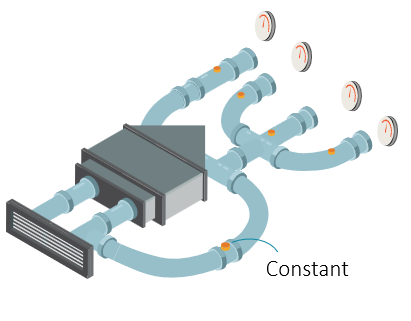
Constant Airflow
A portion of airflow must always be maintained over the indoor coil in any ducted air conditioning system. This is a critical safety measure designed to protect both the ductwork and the AC unit itself. If all zone dampers are closed simultaneously, it can lead to excessive pressure in the ductwork. This may cause flexible ducts to split or detach from spigots, and in some cases, result in the indoor coil freezing over. While modern air conditioning units are equipped with built-in safety features to help prevent coil icing, ensuring continuous airflow remains best practice for system performance and longevity. There are several design strategies available to maintain adequate airflow. The final decision rests with the system designer, and this manual outlines a range of possible solutions to consider.
The installer can configure any number of electronic constant zones within the iZone system. If the system has no electronic constant zones or uses fixed ducted constants (outlets without zones), the installer can select zero constants.
When one electronic constant zone is configured, the system ensures that the total airflow across all open zones plus the constant zone equals at least the equivalent of one zone fully open (100%).
For example: The total open zones equal 150% (1.5 zones fully open). Electronic Constant 1 will open to 50%, while Electronic Constant 2 remains closed to maintain the required total airflow.
Fixed Ducted Constant Zone
One traditional method of maintaining constant airflow across the indoor coil involves designing the system with a dedicated zone that does not include a zone damper. This is typically a main living area in a residential home or a common area in a commercial building. The main drawback of this approach is that conditioned air is always supplied to this area, regardless of occupancy. This reduces the system’s diversity and may require the installation of a larger air conditioning unit, increasing both capital and operating costs. Additionally, when all other zones are closed, air noise in the constant zone can become more noticeable due to the higher airflow being directed through it.
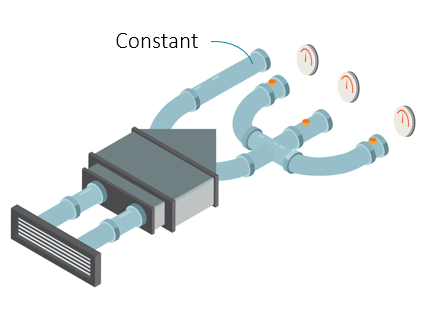
Standard Electronic Constant Zone
In most systems, a zone damper is typically installed in the main living area of a home or a common area in an office. This zone functions like any other but can be automatically overridden to open when the system needs to maintain minimum airflow across the indoor coil. With an iZone system, multiple zones can be configured as electronic constant zones, which will activate or deactivate progressively based on system demand. This provides a more flexible solution than a fixed constant zone. However, while more advanced, electronic constant zones do have some limitations:
- Temperature drift: When a zone is used to relieve excess system pressure, the room may experience temperature fluctuations, leading to discomfort.
- Increased noise: Air noise from outlets may increase when the electronic constant is active, particularly when other zones are closed.
Despite these drawbacks, electronic constant zones offer a more dynamic and efficient alternative to fixed constant zones when properly designed and implemented.
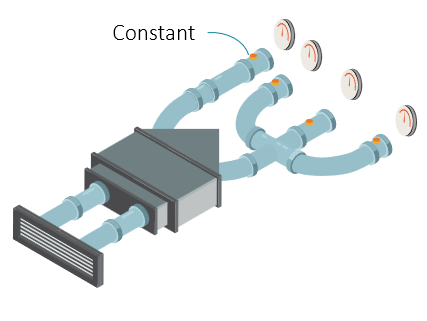
Bypass Constant Zone
In this configuration, an additional zone is installed in the roof space that creates a loop from the supply air side of the A/C fan coil unit back to the return air side. This bypass zone remains closed during normal operation and only opens when the system requires additional airflow to maintain minimum conditions across the indoor coil.
Key Benefits:
- Uninterrupted Comfort: All habitable areas retain full individual temperature control, and the activation of the bypass zone does not affect any occupied or common spaces.
- Silent Operation: As the bypass zone does not discharge air into a room, there is no increase in noise when it operates.
- Improved Efficiency: Since conditioned air is recirculated within the system rather than being discharged into an area, the overall load on the A/C unit is reduced. When combined with control from the unit’s return air sensor, this setup can help the system cycle off sooner, improving energy efficiency.
Recommended Configuration: Based on our experience, the best performance is achieved when systems with individual zone temperature control are designed with a bypass electronic constant zone and the air conditioning unit is controlled-where possible-from the “Zones” rather than the return air sensor alone. It is recommended to enable Advanced Constant Control when a bypass constant zone has been installed